
Zakat is not merely an annual ritual performed during Ramadan or when business profits accumulate. In Islamic jurisprudence, Zakat refers to a specific portion of wealth that a Muslim is obligated to pay, which is then distributed to designated groups of recipients (such as the poor and needy) in accordance with the criteria set by Islamic law (Sharia).
Linguistically, the word Zakat originates from the Arabic root meaning to purify, to grow, to bless, and to praise. This linguistic definition beautifully mirrors the true essence of Zakat: it does not diminish one's wealth; rather, it purifies the soul of the giver and cultivates blessings in the remainder of the wealth kept.
The Theological Foundation: Why is Zakat Obligatory?
As one of the Five Pillars of Islam, the obligation of Zakat stands firmly on indisputable textual evidence from both the Holy Qur'an and authentic Hadiths.
1. Legal Basis from the Qur'an
In the Qur'an, the commandment to pay Zakat is frequently paired directly with the commandment to establish prayer (Salah). This highlights how crucial the social dimension (Zakat) is to complement the personal spiritual dimension (Salah). One of the primary foundations is the Word of Allah Subhanahu wa Ta'ala in Surah At-Tawbah, Verse 103:
"Take, [O, Muhammad], from their wealth a charity by which you purify them and cause them increase, and invoke [Allah's blessings] upon them. Indeed, your invocations are reassurance for them. And Allah is Hearing and Knowing."
Furthermore, this obligation is reaffirmed in Surah Al-Baqarah, Verse 43:
"And establish prayer and give Zakat and bow with those who bow [in worship and obedience]."
2. Legal Basis from Authentic Hadiths
The Prophet Muhammad (peace and blessings be upon him) provided clear details regarding the status of Zakat as a foundation of the faith. In an authentic hadith narrated by Imam Al-Bukhari and Imam Muslim from Abdullah bin Umar (may Allah be pleased with them both), the Prophet said:
"Islam is built upon five pillars: testifying that there is no deity worthy of worship except Allah and that Muhammad is the Messenger of Allah, establishing prayer, paying Zakat, performing Hajj to the House (Ka'bah), and fasting during Ramadan." (HR. Bukhari No. 8 and Muslim No. 16).
When sending Mu'adh bin Jabal to Yemen, the Prophet gave operational instructions that clarified the target audience for Zakat:
"...Inform them that Allah has made Zakat obligatory upon their wealth, to be taken from the rich among them and given to the poor among them." (HR. Bukhari No. 1395).
The Classification of Zakat: Soul and Wealth
Broadly speaking, Islamic law divides Zakat into two main categories that bind every individual Muslim who meets the required criteria.
1. Zakat al-Fitr (Zakat of the Soul)
This is the Zakat that must be paid by every Muslim—male or female, adult or child, and even a newborn baby before the sun sets on the final day of Ramadan. This Zakat serves to purify those who fasted from idle talk and obscenity, and to provide food for the poor.
- Amount of Zakat al-Fitr: Based on an authentic hadith narrated by Al-Bukhari (No. 1503), the amount of Zakat al-Fitr is 1 sa' of staple food (such as dates, barley, or rice, depending on the region). The value of 1 sa' is roughly equivalent to 2.5 kilograms or 3.5 liters of rice per individual.
2. Zakat al-Mal (Zakat of Wealth)
This Zakat is levied on wealth that meets two main conditions: Nisab (the minimum threshold of wealth) and Hawl (the wealth must be held for one full lunar year). The types of wealth subject to Zakat include:
- Gold and silver (including cash savings, bank accounts, or investments).
- Agricultural produce, fruits, and livestock.
- Business or commercial inventory.
- Rikaz (buried treasure/found wealth) and minerals.
Generally, the Zakat rate for gold, silver, and savings is 2.5% of the total wealth once it reaches the nisab equivalent to 85 grams of pure gold.
Who Eligible to Receive It? (The Eight Categories of Mustahik)
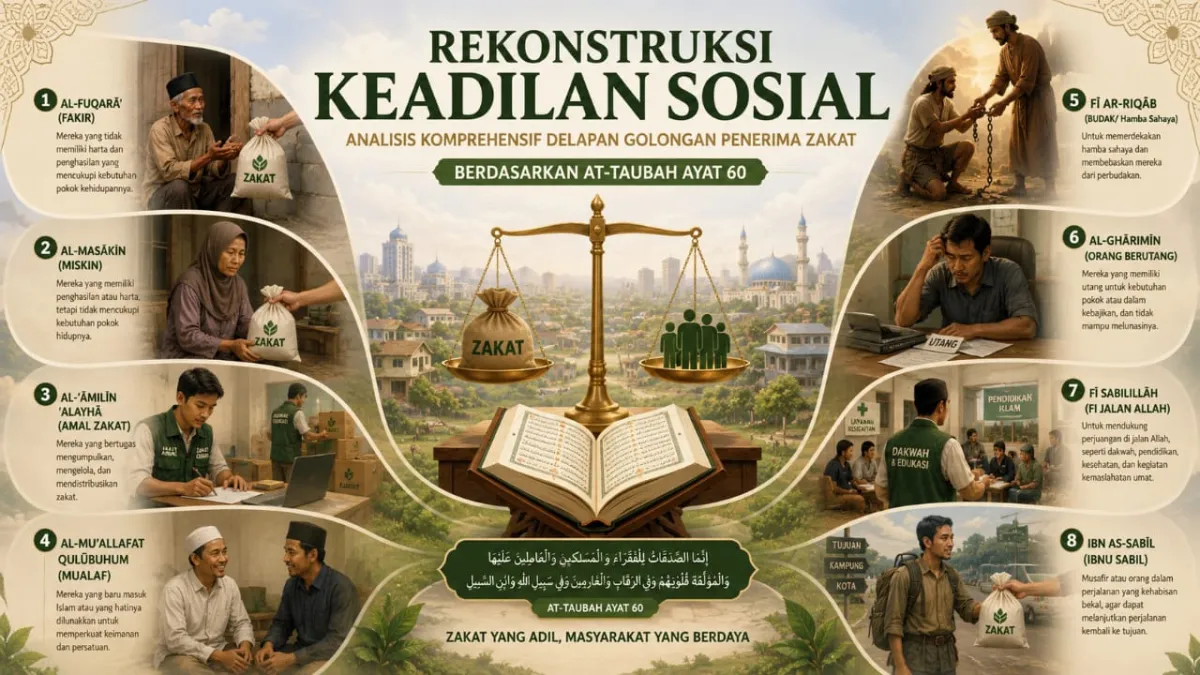
The Qur'an specifically outlines the regulations regarding who is permitted to receive Zakat funds. This ensures that the management of Zakat is transparent and accurate, preventing nepotism or human bias. According to Surah At-Tawbah, Verse 60, there are 8 categories (mustahik) eligible to receive Zakat:
- Fakir (The Destitute): Those who have absolutely no property or income to meet their basic needs.
- Miskin (The Poor): Those who have an income or property, but it is insufficient to cover their daily basic necessities.
- Amil (Zakat Administrators): The official personnel appointed to collect, manage, and distribute Zakat.
- Mu'allaf (Those Reconciled to Islam): Recent converts to Islam who need emotional, social, or financial solidarity to strengthen their faith.
- Riqab (Slaves/Captives): Those in bondage who wish to buy their freedom (in modern contexts, this extends to freeing victims of modern-day human trafficking or slavery).
- Gharimin (Debtors): Individuals overwhelmed by debt incurred for halal (permissible) and urgent needs, not for extravagance or sin.
- Fi Sabilillah (In the Cause of Allah): Individuals or movements striving in the path of Allah for the benefit, welfare, and defense of Islamic values.
- Ibnu Sabil (The Wayfarer): Travelers who run out of provisions or funds during a long journey to return home safely.
The Essence and Real Impact of Zakat on Life
Zakat is not just a rigid religious tax instrument. When analyzed deeply, Zakat carries a magnificent multidimensional impact on the social and economic stability of humanity.
- Eradicating Social Inequality: Zakat bridges the gap between the rich and the poor. Wealth is not meant to circulate solely among the wealthy elite (as warned in the Qur'an, Surah Al-Hashr: 7).
- Mental Purification: For the Zakat payer (muzakki), this act of worship eradicates spiritual ailments like stinginess, greed, and an excessive attachment to worldly possessions. For the recipient (mustahik), Zakat dissolves envy and resentment toward those who are well-off.
- Economic Stimulus: Zakat funds distributed to the underprivileged increase the purchasing power of the community. When domestic consumption rises, the macroeconomic gears turn more efficiently and healthily.
Zakat is a tangible manifestation that Islam is a complete religion one that does not only demand its followers to bow and prostrate before the Creator on a prayer mat, but also compels them to look sideways, extend a helping hand, and ensure that no neighbor goes to sleep hungry.